


Mechanical Fury
Fast-Paced Movement Shooter
Gameplay recordings and procedural tools
Mechanical Fury / selected work
Gameplay and combat
My arena, enemy AI, boss encounter, level systems and reusable tools within the team-developed movement shooter.
3:38 · Development footage · No audio · Editor debug messages remain visible.
Game and technical design
I designed and implemented the combat gameplay, enemy AI, arena and boss encounter featured here. I also built the Blueprint gameplay systems, claw interaction and procedural tools used in the examples below.
Level implementation
I assembled the featured level with team-created models and implemented its gameplay systems. The walkthrough connects illuminated corridors, an interactive chamber, use prompts and a dialogue sequence.
1:34 · Playable result, not the construction process · No audio.
Claw-machine interaction
I connected directional floor buttons to a movable claw using Blueprints and Timelines. Movement, button feedback and object pickup work together in a testable interaction.
1:33 · Prototype controls and pickup · No audio.
Production tools / designer workflow
Procedural level-building tools
I built reusable Blueprint tools to remove repetitive placement work and let designers adjust level geometry and prop arrangements through exposed editor settings. The tool logic is my work; the models were supplied by the art team.
Scaffolding builder
Builds: scaffold structures for the level.
Designer controls: adjust the exposed dimensions to fit the space.
Work removed: rebuilding a repeated structure piece by piece when its size changes.
Wall builder
Builds: repeated wall arrangements.
Designer controls: change wall dimensions to revise the layout.
Work removed: individually duplicating and realigning every repeated section.
Crate-layout tools
Builds: crate groupings, with stacking and pyramid variants.
Designer controls: choose the appropriate tool and adjust the available count settings.
Work removed: manually placing every crate when testing a different arrangement.
Container-layout tools
Builds: reusable container arrangements.
Designer controls: use the exposed size and seed settings to explore variations.
Work removed: recreating each layout from individual containers.
A designer-facing workflow
Place the Blueprint actor in the level, adjust its available settings in the Details panel, inspect the result, and playtest. Return to those settings when the space needs changing. Common layout adjustments do not require editing the underlying graph.
These tools reduce repeated placement work and let designers test layout changes through exposed settings.
Watch the editor-tool demonstration from 2:20
Blueprint graphs remain confidential under NDA. The demonstration shows editor controls and results.
Game and Technical Design
Gameplay systems, combat encounters and Blueprint tools, supported by level design, technical art and VFX.
Mechanical Fury - Trailer
Level Design Contributions
-
Designed and implemented 20+ unique enemy and obstacle encounters requiring fast-paced combat decision-making and spatial awareness. Each encounter carefully choreographed with specific enemy placement, spawn timing, and environmental hazards.
-
Created 12 distinct combat arenas (3-4 per mission sector) with verticality-focused design supporting high-octane movement mechanics. Each arena features 15-25 meter vertical integration and 40-60 meter horizontal expansion.
-
Designed three-phase encounter progression system (Introduction, Escalation, Pressure) creating compelling combat flow and balanced difficulty curves. Systematically tested and iterated based on playtesting data.
-
Built procedural design tools for walls, floors, and background architecture, supporting repeatable level construction while maintaining designer control.
-
Engineered modular trigger system and specialized level systems (Secret Base, Time Trials) enabling rapid prototyping and content reuse across multiple mission sectors.
-
Ran regular playtests, tracking where encounters felt unclear or unfair and refining from there.
-
Created level documentation including top-down arena layouts, encounter flowcharts, blockout comparisons, and technical specifications for team reference and future development.
-
Established visual hierarchy and spatial readability through color-coded platforms, directional lighting, environmental markers, and clear navigation cues ensuring players maintain spatial awareness during intense combat.
VFX & Material Design Contributions
-
Developed VFX systems using Niagara and Cascade with clear, readable feedback for player actions, enemy behaviour, and hazards. Created reusable effect libraries maintaining visual coherence while supporting rapid iteration.
-
Created a library of reusable shader functions and materials for common effects (glow, dissolve, pulse, distortion) that can be combined to create complex visual effects efficiently. These functions accelerated VFX development for future project development.
-
Implemented interactive materials for wall run panels, LED lighting systems, and enemy overlay effects. Designed glitch materials and dynamic environmental responses that communicate the mechanical nature of the world through visual language.
-
Optimized VFX performance implementing object pooling, LOD systems, and batching techniques to hold a consistent 60 FPS on target hardware.
-
Developed VFX manager providing centralized effect spawning, pooling, and cleanup. Implemented GPU-accelerated Niagara simulations for complex effects while maintaining performance standards.
-
Created visual feedback systems ensuring every interactive element and hazard had distinct visual communication. Playtesting verified clarity under all gameplay conditions with iterative refinement based on player feedback.
-
Established visual hierarchy through Niagara particle systems, LED lighting cues, and material design. Balanced visual quality with performance constraints using Niagara's GPU capabilities and Cascade's efficiency.
Project Details
Project Overview
Mechanical Fury is a fast-paced, single-player movement shooter emphasizing high-octane combat and vertical platforming within destructible mechanical environments. The game combines intense action mechanics similar to Doom Eternal and Ghostrunner with a protagonist equipped with a mechanical arm capable of grappling, kicking, and wielding diverse weapon systems against hordes of mechanical enemies in vertically-designed arenas.
As the Level Designer, I was responsible for the complete level design pipeline: from initial concept and paper maps through greyboxing, encounter choreography, and final polish. I designed and implemented all 20+ enemy encounters, created 12 distinct combat arenas with verticality-focused layouts, developed procedural tools to accelerate workflow, and established the three-phase encounter progression system. My work focused on creating levels that support both high-speed traversal and precision combat while maintaining spatial clarity and tactical depth.
The Challenge
Design and implement 20+ unique enemy and obstacle encounters for a fast-paced movement shooter requiring genuine skill and spatial awareness. Each encounter needed to use verticality, support high-octane combat flow, and provide clear visual communication. The primary challenge was creating levels that support both high-speed traversal and precision combat without overwhelming the player, while maintaining readability at high speeds and providing enough tactical depth for complex enemy encounters.
Goals & Features
Project Goals
- Designed fast-paced combat encounters requiring genuine skill and spatial awareness
- Created verticality-focused arena layouts supporting movement shooter mechanics
- Implemented visual feedback systems for clarity under high-pressure gameplay
- Developed technical systems enabling rapid iteration and content prototyping
Key Features
- Fast-paced movement shooter with emphasis on verticality
- Mechanical arm mechanics (grappling, kicking, weapons)
- 20+ enemy encounters with varied behavioral patterns
- Custom VFX systems using Niagara and Cascade
- Procedural generation tools for level construction
- Modular trigger system for event sequencing
Design Process
Phase 1: Research & Analysis
Analyzed successful movement shooter level design from competitive titles (Doom Eternal, Ghostrunner) to understand core design patterns for fast-paced combat environments. Studied how verticality creates tactical positioning options and how environmental hazards create meaningful risk/reward scenarios.
Key Findings:
, Verticality creates tactical positioning options and encourages aggressive movement
Clear visual hierarchy ensures rapid spatial comprehension during intense gameplay
Environmental hazards create meaningful risk/reward scenarios
Arena design impacts encounter difficulty and combat flow
Deliverables:
Competitive analysis document, arena design principles, enemy encounter frameworks, visual clarity guidelines
Phase 2: Procedural Systems & Technical Infrastructure
Created reusable technical infrastructure to accelerate level design iteration. Developed procedural systems for environmental generation and modular encounter frameworks that enabled rapid prototyping of combat scenarios.
Technical Systems Developed:
, Modular Encounter Design System: Reusable enemy encounter framework with configurable parameters
Procedural Wall & Floor System: Automated tiling system with collision generation
Procedural Building System: Generated secondary architecture maintaining stylistic consistency
Custom Editor Tools: Enemy spawner, playtest helpers, debug visualization
Deliverables:
Modular encounter system, procedural generation tools, custom editor scripts, technical documentation
Phase 3: Combat Arena Design & Encounter Choreography
Designed 3-4 distinct combat arenas per mission sector with specific spatial characteristics supporting movement shooter mechanics. Created three-phase encounter progression framework ensuring balanced difficulty curves.
Arena Design Framework:
, Horizontal Expansion: 40-60 meter play spaces enabling lateral movement
Vertical Integration: 15-25 meter height variations supporting grappling mechanics
Non-Linear Pathing: Multiple interconnected routes preventing bottlenecking
Cover Zones: Strategic architectural placement for tactical positioning
Encounter Progression (Three Phase Structure):
Phase 1 - Introduction: Single/dual enemy spawns for spatial assessment
Phase 2 - Escalation: Progressive enemy count increase with varied abilities
Phase 3 - Pressure: Maximum enemy density forcing continuous forward momentum
Phase 4: VFX Development & Polish (Niagara & Cascade)
Developed VFX systems using Unreal Engine's Niagara and Cascade particle systems to provide visual feedback for all player interactions. Created reusable effect libraries that maintained visual coherence while supporting rapid iteration.
VFX Systems Implemented:
, Niagara Core Effects: Glow/emissive systems, dissolve effects, pulse systems, distortion effects
Cascade Legacy Effects: Electrical spark systems, explosive impacts, environmental hazards
Interactive Materials: Glitch materials, wall run panels, LED lighting systems
Co-op Shader: Rim-light visibility system for multiplayer scenarios
Deliverables:
reusable VFX functions, material libraries, performance optimization guidelines, visual feedback documentation
Phase 5: Performance Optimization & Polish
Conducted performance optimization ensuring 60 FPS on target hardware. Implemented object pooling, LOD systems, and batching techniques to hold a steady frame rate on target hardware.
Optimization Techniques:
, Object Pooling: Eliminated runtime allocation overhead for particle effects
LOD Systems: Reduced shader complexity based on camera distance
Batching & Instancing: draw-call optimisation
GPU Optimization: Minimized GPU overhead through efficient shader calculations
Performance Results:
60 FPS maintained on mid-range PC hardware | 60% memory allocation reduction | 50% draw call reduction | Zero perceptible performance degradation with full VFX active
Technical Implementation
Tools & Technologies
Primary
Tools:
Unreal Engine 5.3,
Visual Studio, Niagara VFX, Cascade, Git Version
Control
Additional
Tools:
Blender (for
asset preparation), Photoshop (for texture work),
Miro (for
design
documentation)
Modular Encounter System
Base encounter class with standardized enemy spawning and behavior management. Configurable enemy compositions enabling rapid testing of enemy combinations. Behavior parameters for enemy pathing, attack timing, and difficulty scaling. Encounter progression logic managing transition between combat phases.
Procedural Content Generation Tools
Procedural Wall & Floor System: Automated tiling system generating environmental surfaces with collision, supporting parameter-driven iteration.
Procedural Building System: Generated secondary architecture (walls, structural supports, background elements) maintaining stylistic consistency.
Custom Editor Tools Suite: Enemy encounter spawner for rapid placement and configuration | Playtest helper systems with performance profiling | Debug visualization for pathing, collision zones, and hazard areas.
VFX Systems (Niagara & Cascade)
VFX manager: Centralized effect spawning, pooling, and cleanup implementing object pooling for performance.
Niagara Effects Library: reusable particle systems for combat feedback, environmental effects, and player interactions. GPU-accelerated simulations for complex effects maintaining 60 FPS.
Cascade Legacy Systems: Traditional particle effects for specific environmental hazards and explosions. Optimized for consistency with existing game assets.
Master Trigger System Architecture
Hierarchical trigger system enabling complex event sequencing with base trigger class defining trigger interface and communication protocols. Inherited trigger types: TimerTrigger, ProximityTrigger, DamageThresholdTrigger, StateChangeTrigger. Signal broadcast system enabling multiple subscribers to single trigger events. Eliminated code duplication across 50+ trigger implementations.
Secret Base System
Specialized level prototype featuring complete level instance with animated environmental materials, advanced trigger systems managing sequential sequences, boss encounter preparation framework with VFX staging, post-encounter environmental transformation system, and dynamic post-processing volume integration. Designed for systematic reuse across diverse locations.
VFX & Shader Systems
VFX Manager
System:
Centralized VFX management system that handles
effect
spawning,
pooling, and cleanup.
Custom Shader Library
Developed reusable shader functions using Niagara and Cascade for common effects (glow, dissolve, pulse, distortion). These functions can be combined to create complex visual effects efficiently.
Performance Optimization
VFX
Optimization: Reduced draw
calls through batching and instancing.
Implemented LOD system
for particle effects based on camera distance.
Memory
Management: Implemented
object pooling for all particle effects and
temporary
game objects.
Reduced memory pressure during
gameplay.
Frame
Rate:
Maintained
consistent 60 FPS on target hardware (mid-range
PCs)
even with maximum
VFX running simultaneously.
Visual Documentation
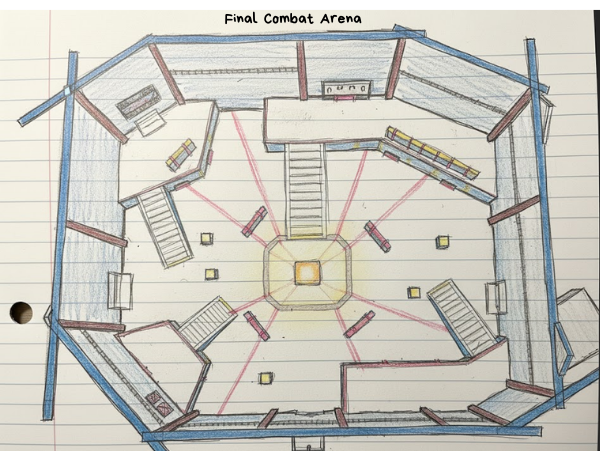
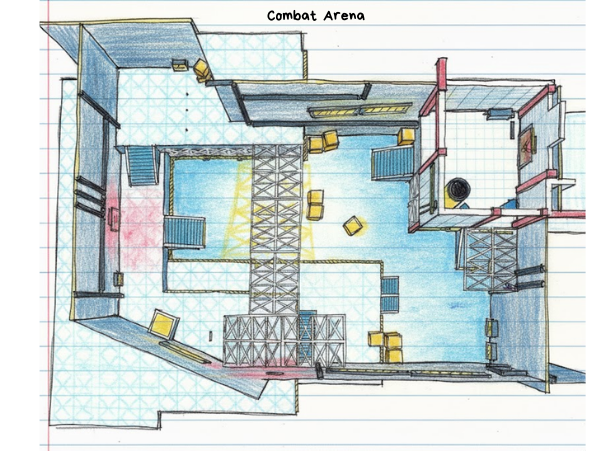
2D Layout
Top-Down Arena Flow: Created detailed layouts showing obstacle placement, enemy spawn points, player paths, and interaction zones. Each encounter annotated with required ability usage, optimal player positioning, and tactical flow.
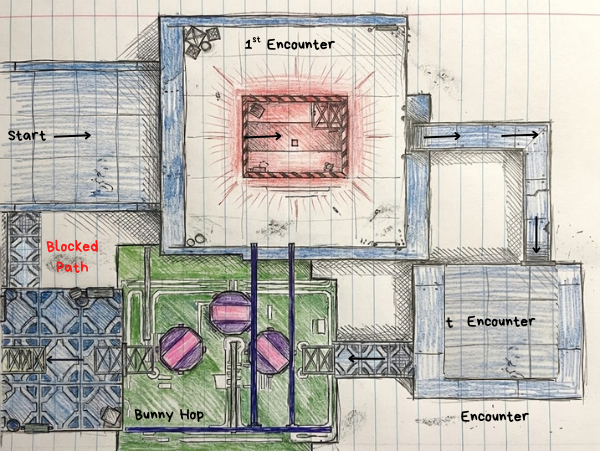
Encounter Flow & Progression
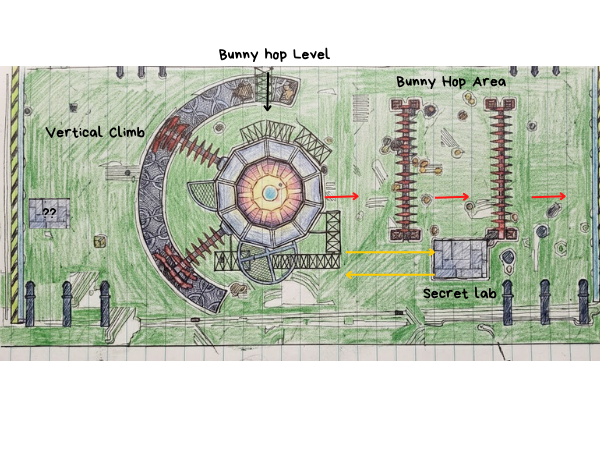
Central Arena & Bunny Hop Area
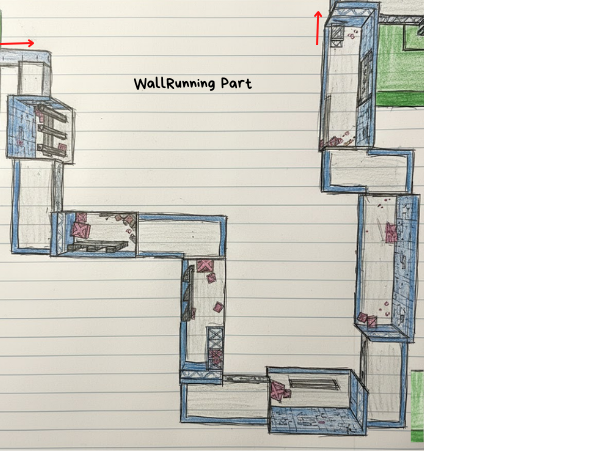
Wall Running Section
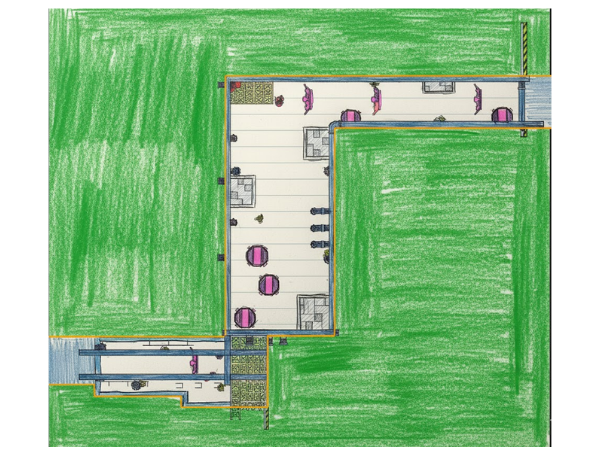
Building Layout & Interior Design
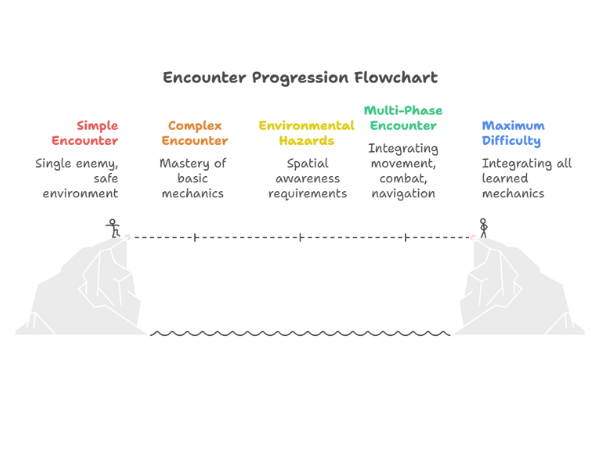
Encounter Progression Flowchart
Design Flow: Documented the progression of encounters from simple single-enemy challenges to complex multi-phase scenarios requiring spatial mastery and combat skill.
Step-and-Spike Difficulty Curve:
Step 1: Single enemies in safe environments establishing core combat mechanics
Spike 1: Complex encounter requiring mastery of basic movement and combat
Step 2: Environmental hazards introducing spatial awareness requirements
Spike 2: Multi-phase encounter integrating movement, combat, and hazard navigation
Final: Maximum difficulty scenario integrating all learned mechanics
Blockout vs Final Comparison
Iteration Showcase: Side-by-side comparisons of initial blockouts versus final implementations, demonstrating how playtesting feedback and optimization shaped final designs.
From Greybox to Polish:
Early blockouts focused on collision metrics and readability using primitive shapes. Final art pass replaced primitives with mechanical textures, dynamic lighting, and VFX. Maintained all metrics established in greybox phase.
Arena Screenshots & In-Game Views
In-Game Visuals: Screenshots from gameplay showing verticality, spatial flow, and encounter design in action.
Final Combat Arena
Combat Arena Layout
Challenges & Solutions
Balancing Verticality with Readability
Players often lost track of enemies and objectives in complex vertical environments, leading to frustration and disorientation during combat.
Implemented clear visual hierarchy using color-coded platforms, directional lighting, and environmental markers. Conducted 5+ playtesting sessions to validate spatial comprehension.
Performance with Heavy VFX Load
Initial VFX implementations caused significant performance drops during intense combat, especially with multiple enemies and complex shader effects.
Developed object pooling system and LOD-based VFX scaling. Kept draw calls in check and held a consistent 60 FPS while keeping the VFX sharp.
VFX Performance Optimization
Initial VFX implementations using Niagara and Cascade were causing significant frame rate drops, especially with multiple simultaneous effects and intense gameplay moments. Complex particle systems were overwhelming the GPU during peak combat scenarios.
Optimized particle systems by implementing LOD systems for both Niagara and Cascade effects. Created object pooling for particle emitters and developed GPU-efficient Niagara modules. This maintained visual quality while ensuring smooth 60fps gameplay even with all effects active simultaneously.
Enemy Encounter Balance
Designing 20+ encounters that were simultaneously challenging, fair, and visually clear proved difficult. Early prototypes were either trivial or frustratingly difficult without proper difficulty scaling.
Developed systematic encounter design with clear difficulty progression using the three-phase framework. Created playtesting protocols identifying when encounters deviated from design intent. Iterated based on observation of player decision-making patterns and tactical choices, ensuring encounters remained engaging and fair.
Technical Depth vs. Development Speed
Building procedural systems and custom editor tools required significant technical development time, competing with content creation timelines for 20+ encounters and multiple combat arenas.
Front-loaded technical infrastructure development, understanding that solid systems would accelerate content creation. This systems-first approach enabled rapid iteration on encounter design and VFX implementation, ultimately saving development time despite initial infrastructure investment.
Visual Clarity in Complex Environments
Maintaining visual clarity during intense multi-enemy combat while supporting advanced VFX systems required careful design balance. Too many effects created visual noise; too few left players without proper feedback.
Developed clear visual hierarchy through Niagara particle systems, LED lighting cues, and material design. Ensured every interactive element and hazard had distinct visual communication. Playtesting verified clarity under all gameplay conditions, with iterative refinement based on player feedback.
Rapid Level Iteration Speed
Manual placement of walls and floors was too slow for the required content output, creating a bottleneck in level production.
Created procedural generation tools for walls, floors, and architecture. Accelerated level construction workflow while maintaining artistic control.
Design Elements
Character Mechanical Systems
Designed mechanical arm mechanics featuring multiple interaction types (grappling, kicking, weapon systems) creating diverse gameplay possibilities within combat encounters. Each mechanic was integrated into arena design and encounter choreography to create cohesive combat flow.
Enemy Variety
Created multiple enemy types with distinct behaviors and attack patterns: ranged attackers creating distance challenges, melee-focused enemies encouraging vertical escape, special ability enemies adding tactical complexity, and boss encounters requiring synthesis of all learned mechanics.
Visual Feedback Systems
Implemented VFX systems using Niagara and Cascade providing clear feedback for enemy behaviors, environmental hazards, player ability effectiveness, and damage indication. Every interaction has immediate visual confirmation through optimized particle systems.
Environmental Storytelling
Designed interactive materials and environmental elements communicating the mechanical nature of the world through glitch patterns on displays, LED strip lighting as navigation cues, mechanical visual language in architecture, and dynamic environmental responses to combat.
Results & Impact
Level Design Achievements
20+ unique enemy encounters designed, prototyped, and implemented with systematic difficulty progression
12 distinct combat arenas (3-4 per mission sector) with verticality-focused layouts supporting movement mechanics
Readable spaces players could parse fast, confirmed in playtesting
Parameter-driven iteration from procedural tools and modular systems
Technical Level Design Systems
Modular encounter setup enabling rapid iteration and content reuse across multiple mission sectors
Procedural generation tools for walls, floors, and architecture maintaining artistic control
Reusable trigger system that cut duplicated Blueprint logic across encounters
Custom editor tools for enemy spawners, playtest helpers, and debug visualization
Design Process & Methodology
Regular playtests, tuning encounters around how players moved and fought
Three-phase encounter progression system (Introduction, Escalation, Pressure) creating balanced difficulty curves
Clear documentation including level layouts, encounter flowcharts, and technical specifications
Playtest-driven iteration based on player decision-making patterns and tactical choices
Level Design Impact
Clear visual hierarchy enabling rapid spatial comprehension during intense high-speed gameplay
Effective encounter choreography creating compelling combat scenarios requiring genuine skill
Solid procedural systems enabling rapid content iteration for future episodes
Balanced difficulty progression ensuring encounters remain challenging yet fair through systematic design
Lessons Learned
System-First Approach
Investing in solid technical systems early (modular encounter components, VFX manager, procedural tools, custom editor tools) provided supported reuse throughout development. This reinforced the importance of technical infrastructure over ad-hoc content creation.
VFX as Gameplay Communication
Working with Niagara and Cascade taught me that VFX serve critical gameplay functions beyond aesthetics: guiding players, indicating state, providing feedback, and supporting tactical decisions. Understanding when to use GPU-accelerated Niagara versus traditional Cascade became essential to performance optimization.
Encounter Design Psychology
Designing encounters that were simultaneously challenging and fair required extensive playtesting. Small adjustments (enemy timing, visual cues, hazard placement) dramatically improved experience. Understanding player psychology and decision-making patterns became essential to encounter design.
Data-Driven Iteration
Collecting quantitative playtesting data (completion metrics, decision points, confusion areas) provided objective insights guiding design decisions. This data-driven approach proved more effective than intuition-based design for balancing 20+ unique encounters.
Performance-Conscious Development
Optimizing VFX and systems throughout development rather than as final step maintained smooth performance and prevented costly rework. Learning to balance visual quality with performance constraints using Niagara's GPU capabilities and Cascade's efficiency became standard practice.